

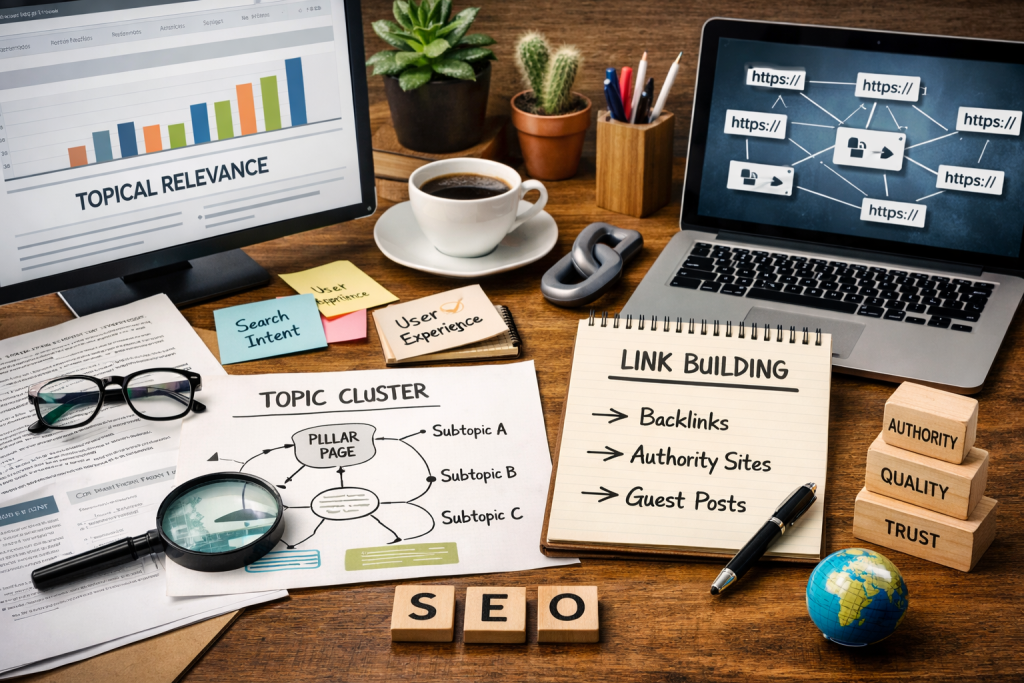
Search engine optimization has undergone a profound transformation over the past decade. What once revolved heavily around acquiring as many backlinks as possible has now evolved into a far more nuanced system driven by relevance, intent, and authority. Today, the debate between topical relevance and link power is no longer about choosing one over the other. Instead, it is about understanding how these forces interact and which one truly drives rankings in the modern search landscape.
This article explores the shift in ranking dynamics, examines the role of each factor, and explains what actually moves rankings today.
The Evolution of Ranking Signals
Search engines have always relied on multiple signals to determine rankings. However, their priorities have shifted significantly.
In earlier years, backlinks were considered the strongest ranking factor. Websites could climb search results simply by acquiring a high volume of links, regardless of content quality. This led to widespread manipulation and spam.
Today, the algorithm has matured. Content quality, user intent, and topical coverage now play a central role in determining visibility. Search engines evaluate hundreds of signals, but the emphasis has clearly shifted toward relevance and expertise rather than raw link volume.
Understanding Topical Relevance
Topical relevance refers to how well a piece of content aligns with a specific subject and satisfies user intent. It is no longer about inserting keywords into a page but about demonstrating a deep understanding of a topic.
What Defines Topical Relevance
Modern search engines analyze:
- Depth of content
- Coverage of related subtopics
- Semantic relationships between terms
- Context and intent alignment
Topical relevance is strengthened when content covers an entire subject comprehensively rather than focusing on isolated keywords. This includes using related concepts, entities, and structured information that signal expertise.
The Rise of Topical Authority
Topical relevance becomes even more powerful when scaled across a website. This is known as topical authority.
Websites that publish interconnected content around a specific niche build stronger credibility signals. Instead of ranking individual pages, search engines begin to trust the entire domain as an authority on that subject.
Studies show that comprehensive topical coverage is now one of the strongest on page signals associated with higher rankings.
Understanding Link Power
Link power, often referred to as backlink authority, remains a foundational component of SEO. It reflects how other websites perceive and validate your content.
What Makes Links Powerful
Not all links are equal. Modern link evaluation focuses on:
- Relevance of the linking site
- Authority of the domain
- Context in which the link appears
- Editorial placement
A single high quality link from a relevant source can outweigh dozens of low quality links.
The Changing Role of Backlinks
Backlinks are no longer the primary driver of rankings. Instead, they act as trust signals.
They help search engines validate whether your content deserves to rank, but they cannot compensate for poor content. Evidence suggests that while links still influence rankings, their relative impact has declined compared to previous years.
Topical Relevance vs Link Power: Key Differences
1. Core Function
- Topical relevance determines whether your content deserves to rank
- Link power determines whether your content can compete
2. Dependency
- Topical relevance is foundational
- Link power is supportive
Without relevance, links cannot sustain rankings. However, without links, even great content may struggle to gain visibility in competitive spaces.
3. Sustainability
- Topical relevance provides long term ranking stability
- Link power can create short term boosts
Websites built on strong topical authority tend to maintain rankings even during algorithm updates.
What Actually Moves Rankings Today
The modern SEO landscape is not dominated by a single factor. Instead, it is driven by the interaction between multiple signals, with topical relevance taking the lead.
1. Content Depth and Coverage
Search engines prioritize content that thoroughly answers user queries. Pages that cover a topic in depth consistently outperform shallow content.
High performing pages often include:
- Detailed explanations
- Supporting subtopics
- Real world examples
- Clear structure
This comprehensive approach signals expertise and increases ranking potential.
2. Search Intent Alignment
Matching user intent is critical. Even well written content will fail if it does not align with what users are actually searching for.
Search engines analyze:
- Query type
- User behavior
- Engagement signals
Pages that satisfy intent are rewarded with higher rankings and better visibility.
3. Topical Clustering and Internal Linking
Content clusters play a major role in building authority. A well structured site connects related articles through internal links, creating a network of knowledge.
This helps search engines:
- Understand topic relationships
- Identify expertise
- Index content more efficiently
Topical clustering is one of the most effective strategies for building long term ranking power.
4. Quality Backlinks
While not dominant, backlinks still play a critical role.
They:
- Validate authority
- Accelerate ranking potential
- Improve discoverability
However, the focus has shifted to quality and relevance rather than quantity. Editorial links from trusted sources have the strongest impact.
5. User Experience and Engagement
User behavior signals have become increasingly important.
These include:
- Click through rates
- Time on page
- Bounce rates
Search engines use these signals to evaluate whether users find your content valuable. Positive engagement reinforces rankings.
The Real Winner: A Hybrid Approach
The debate between topical relevance and link power is ultimately misleading. The most successful SEO strategies combine both elements.
Why Topical Relevance Comes First
Topical relevance forms the foundation of ranking success. Without it:
- Content lacks credibility
- Search engines cannot determine expertise
- Users do not engage
This makes it the primary driver of rankings.
Why Link Power Still Matters
Link power amplifies visibility. It helps:
- Break into competitive SERPs
- Establish trust signals
- Increase authority faster
However, it works best when built on strong content.
Common Misconceptions
Misconception 1: Backlinks Are Dead
Backlinks are not obsolete. They remain a key ranking factor but have evolved. Their effectiveness now depends on relevance and context rather than volume.
Misconception 2: Content Alone Is Enough
Even the best content may struggle without links, especially in competitive niches. Authority still needs validation.
Misconception 3: More Content Equals Better Rankings
Publishing large amounts of content without structure or relevance does not build authority. Quality and depth matter more than quantity.
Practical Strategy for 2026 and Beyond
To succeed in modern SEO, businesses must adopt a balanced and strategic approach.
Step 1: Build Topic Clusters
Focus on one niche and create interconnected content that covers every aspect of the subject.
Step 2: Optimize for Intent
Understand what users are searching for and tailor content accordingly.
Step 3: Strengthen Internal Linking
Create logical connections between related pages to reinforce topical authority.
Step 4: Earn High Quality Links
Prioritize links from relevant and authoritative sources rather than chasing volume.
Step 5: Improve User Experience
Ensure fast loading times, clear structure, and engaging content to enhance user satisfaction.
Conclusion
The modern SEO landscape is defined by a clear shift toward relevance and expertise. Topical relevance has emerged as the primary driver of rankings, supported by link power and user engagement signals.
Rather than choosing between the two, successful strategies integrate both elements. Content must first demonstrate deep expertise and align with user intent. Only then can backlinks amplify its impact.
In simple terms, topical relevance earns rankings, while link power accelerates them.